


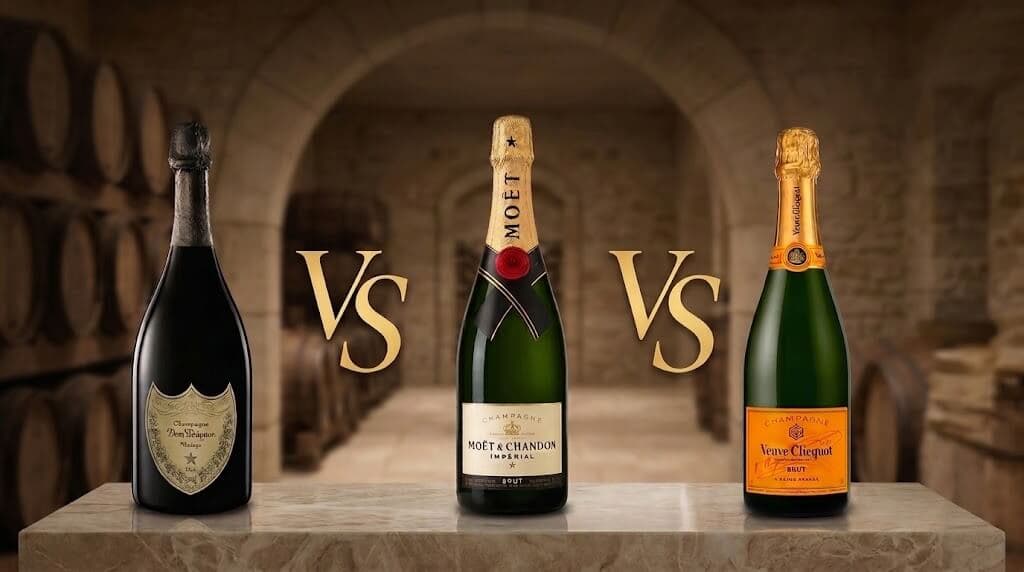
Moët & Chandon is the crowd-pleaser for casual celebrations and groups. Veuve Clicquot is the safest premium gift — bolder taste, instantly recognizable yellow label. Dom Pérignon is the statement gift for milestones: vintage-only, aged at least eight years, unmistakable prestige. Match the bottle to the size of the moment, and you can't go wrong.
Here's the twist most gift-buyers don't know: all three come from the same parent company, LVMH — and Dom Pérignon is actually made by Moët & Chandon itself. Yet in taste, price, and the message each bottle sends, they could hardly be more different.
Below, we compare all three on taste, price, occasion fit, and presentation, then settle each head-to-head — so you can pick with confidence and make the celebration land.
At a Glance: Moet vs. Veuve Clicquot vs. Dom Perignon
| Factor | Moet & Chandon | Veuve Clicquot | Dom Perignon |
|---|---|---|---|
| Price (verified July 2026) | ~$50–$65 | ~$55–$75 | ~$200–$280+ |
| Taste profile | Fruity, light, approachable | Bold, toasty, Pinot Noir-forward | Complex, mineral, layered |
| ABV | 12% | 12% | 12.5% |
| Body | Light | Medium | Full |
| Vintage? | Mostly non-vintage (Impérial) | Mostly non-vintage (Yellow Label) | Vintage only, aged 8+ yrs |
| Packaging | Classic gold label | Iconic yellow label | Minimalist prestige shield |
| Grape blend | Pinot Noir 30–40%, Meunier 30–40%, Chardonnay 20–30% | Pinot Noir 50–55%, Chardonnay 28–33%, Meunier 15–20% | Chardonnay and Pinot Noir only (varies by vintage) |
| Reserve wines | 20–30% | Up to 45% | None (single harvest) |
| Dosage | 7 g/L | 9 g/L | Brut (varies by vintage) |
| House | Épernay, founded 1743 | Reims, founded 1772 | Moët & Chandon's prestige cuvée, first released 1936 |
Sources: blend, reserve-wine and dosage figures from moet.com and veuveclicquot.com; Dom Pérignon aging from LVMH.
Which Champagne Should You Choose? By Occasion
Not sure which bottle fits the moment? Find your occasion below.
| Occasion | Best pick | Why it fits |
|---|---|---|
| Wedding toast (many bottles) | Veuve Clicquot or Moët Impérial | Realistic for a full guest list |
| Gift for the couple | Dom Pérignon Vintage | A keepsake bottle for their first anniversary |
| Milestone anniversary or birthday | Dom Pérignon | The vintage story becomes part of the gift |
| Retirement or major promotion | Dom Pérignon | Signals real weight |
| New job, team win, work anniversary | Veuve Clicquot | Premium without being over the top |
| Client and corporate gifts | Veuve Clicquot | Recognizable and easy to gift in volume |
| Birthday, housewarming, thank-you | Veuve Clicquot or Moët | Thoughtful, or budget-friendly |
| NYE, holidays, big parties | Moët Impérial | Easy-drinking, and pours generously across a crowd |
| Valentine's, proposal, date night | Moët Rosé or Veuve Rosé | Rosé sets the romantic mood |
About the Brands
Moët & Chandon — The World's Most Loved Champagne
Founded in 1743, Moët & Chandon is the world's largest champagne producer, poured everywhere glamour happens, from Formula 1 podiums to New Year's Eve countdowns.
Its signature Moët Impérial is blended from more than 100 wines to keep the house style consistent year after year: bright, easy, celebratory. Moët Rosé Impérial adds a romantic option for gifting. Learn more in our complete Moët & Chandon guide.
Veuve Clicquot — The Widow Who Changed Champagne
Veuve Clicquot's story is the best in champagne. In 1805, Barbe-Nicole Ponsardin, widowed at 27, took over her late husband's struggling wine house and refused to let it fail.
She invented the riddling table, the clarifying technique still used across the entire champagne industry today, and built the house the world now knows as Veuve ("widow") Clicquot.
With a higher share of Pinot Noir in the blend, her champagne drinks bolder and richer than Moët, and its Yellow Label is arguably the most recognizable gift bottle on earth. Explore our full Veuve Clicquot guide.
Dom Pérignon — Moët Prestige Cuvée
Dom Pérignon isn't a separate champagne house; it's Moët & Chandon's prestige label, named for the Benedictine monk credited with pioneering champagne-making.
Two rules set it apart: it is made only in years when the harvest is exceptional (if the year isn't good enough, no Dom Pérignon is released at all), and every vintage ages at least eight years before it leaves the cellar.
That patience is what you're paying for and what makes it the pinnacle of luxury gifting. Read our Dom Pérignon ultimate guide.
How Each One Actually Tastes
Moët & Chandon
Bright, youthful fruit: peach, green apple, a touch of citrus over a soft, creamy mousse. Designed to be immediately enjoyable. This is champagne built for charm, not contemplation.
Veuve Clicquot
More weight on the palate, thanks to the Pinot Noir. Expect brioche and toasted bread wrapped in a smooth, vibrant texture bold enough to impress, balanced enough to please almost anyone.
In 2020, Drinks International's survey of 106 top bars named Veuve Clicquot the best-selling champagne in the world, unseating Moët, proof the bolder style has range.
Dom Pérignon
Years of aging bring deep layers of toast, biscuit, and vanilla, a fuller body, and a long, mineral-driven finish that keeps unfolding in the glass. This isn't a champagne you rush; it's one you sit with.
In simple terms: Moet is fresh and fruity, Veuve is richer and toastier, while Dom Perignon is more layered and complex.
Vintage vs. Non-Vintage: How Moët, Veuve Clicquot & Dom Pérignon Compare
Moët & Chandon (Vintage & Non-Vintage)
Moët & Chandon offers both non-vintage and vintage Champagnes. Its flagship Moët Impérial is a non-vintage Champagne, crafted by blending wines from multiple harvest years to maintain a consistent house style.
For those seeking a more premium experience, the Grand Vintage collection is produced only in selected years when the harvest is considered exceptional.
Veuve Clicquot (Vintage & Non-Vintage)
Like Moët & Chandon, Veuve Clicquot produces both non-vintage and vintage Champagnes. Its iconic Yellow Label Brut is the brand's signature non-vintage expression, while Veuve Clicquot Vintage is released only in exceptional harvest years, offering greater complexity and aging potential.
Dom Pérignon (Vintage)
Dom Pérignon takes a completely different approach. Every bottle is a vintage Champagne, meaning it is made exclusively from grapes harvested in a single exceptional year.
If the quality of a harvest doesn't meet the house's standards, Dom Pérignon simply doesn't declare a vintage, making each release more exclusive and highly anticipated. Learn more in our vintage vs. non-vintage Champagne guide.
Grape Blend — What's Actually in the Bottle
The grape blend plays a major role in shaping a Champagne's flavor, texture, and overall character. Although Moët & Chandon, Veuve Clicquot, and Dom Pérignon are all made from the three classic Champagne grapes, each house uses a different blend, giving its wines a distinct personality.
Moët — Fresh & Fruit-Forward
Moët & Chandon typically uses a balanced blend of Pinot Noir, Chardonnay, and Pinot Meunier (roughly 30–40% Pinot Noir, 30–40% Meunier and 20–30% Chardonnay), with Pinot Meunier playing a more prominent role than in many other Champagne houses. This contributes to the brand's fresh, fruit-forward, and approachable style.
Veuve Clicquot — Bold & Structured
Veuve Clicquot places a stronger emphasis on Pinot Noir than the other two brands: 50–55% of the Yellow Label blend. This higher proportion of Pinot Noir contributes to its richer, fuller-bodied, and more structured style.
Dom Pérignon — Complex & Refined
Dom Pérignon typically uses only Pinot Noir and Chardonnay, in a roughly balanced split — no Pinot Meunier at all. This more focused, restrained blend is part of what gives it that layered complexity and long finish.
Head-to-Head Verdicts
Veuve Clicquot vs. Dom Pérignon — Is DP Worth 3x the Price?
Yes, when the moment justifies it. The price gap ($55–$75 vs. $200+) buys vintage-only production, at least eight years of cellar aging, and scarcity: Dom Pérignon simply doesn't exist in off years. That story is what you're paying for, while Veuve Clicquot offers a premium Champagne experience at a significantly more accessible price.
The middle step nobody mentions: Veuve Clicquot's own prestige cuvée, La Grande Dame (~$170–$200), splits the difference: prestige-level champagne with the Clicquot story attached. If your recipient loves Veuve, it's the smartest upgrade in this comparison. Read the full Veuve Clicquot vs. Dom Pérignon comparison.
Moët vs. Dom Pérignon — Same House, Different League
This is a comparison of rungs on one ladder, since Moët makes both. Moët Impérial (~$50–$65) is the everyday celebration bottle. Moët Grand Vintage (~$75–$95) adds a single-year character. Dom Pérignon ($200+) is the top rung: stricter grape selection, more than three times the aging, and a name that needs no explanation.
Why is it so expensive? Vintage-only scarcity, eight-plus years of lees aging, and fruit sourced from Grand Cru and Premier Cru vineyards. If you want that extra aging and scarcity, Dom Pérignon is worth the investment. Read the full Dom Pérignon vs. Moët comparison.
Moët vs. Veuve Clicquot — A Taste Decision, Not a Budget One
These two sit within about $10 of each other, so forget price — this one comes down to style. Moët is lighter and fruitier, while Veuve is richer, toastier, and reads a notch more premium thanks to that yellow label.
Think of it this way: Moët is the toast; Veuve is the conversation. Prefer something sweeter? Moët Nectar Impérial and Veuve Clicquot Rich are each house's dessert-friendly answer. Read the full Moët vs. Veuve Clicquot comparison.
Packaging & the Unboxing Moment
When you're gifting Champagne, presentation matters almost as much as what's inside the bottle. Moët & Chandon keeps things timeless with its signature gold label and elegant bottle design, making it a versatile choice for almost any celebration.
Veuve Clicquot instantly stands out with its iconic Yellow Label, one of the most recognizable Champagne designs in the world, giving the gift an unmistakable luxury appeal. Dom Pérignon, by contrast, embraces understated elegance with its matte bottle and distinctive shield label, creating a refined look that reflects its prestige.
To make the gift even more memorable, consider pairing the Champagne with premium accessories such as Godiva chocolates, Tiffany crystal flutes, gourmet treats, or a luxury wooden gift box.
A personalized greeting card or an engraved bottle can also add a thoughtful touch, transforming a premium bottle into a keepsake the recipient will remember long after the celebration.
Bottle Sizes & Gift Editions: Make It Bigger or Rarer
Every bottle in this guide comes in more than the standard 750 ml. A small format keeps the gift light, a big format turns it into the centerpiece of a party, and a limited edition makes it a keepsake.
| Format | Moët & Chandon | Veuve Clicquot | Dom Pérignon |
|---|---|---|---|
| Half bottle (375 ml) | — | 375 ml + Godiva set | — |
| Magnum (1.5 L) | Impérial Brut magnum | Yellow Label magnum | Vintage magnum |
| Jeroboam (3 L) | Brut 3 L | Yellow Label 3 L | Vintage 3 L |
| Methuselah (6 L) | — | Yellow Label 6 L | — |
| Gift packaging and editions | — | Ice Jacket, Smeg fridge gift box | Lady Gaga, Basquiat, Murakami and Luminous editions |
A magnum holds two standard bottles (about 10–12 flutes), and a 3-liter holds four. Bigger bottles are also said to age more gracefully, because there is less air in the bottle relative to the wine. See our magnum gift guide or shop all magnum gifts.
How to Serve It (Tell the Recipient, Too)
Temperature: 8–10°C (46–50°F) for Moët and Veuve; let Dom Pérignon warm slightly toward 10–12°C (50–54°F) so the aromas open up. About 3–4 hours in the fridge, or 30 minutes in an ice-water bucket.
Glasses per bottle: A standard 750 ml bottle pours 5–6 flutes. Plan one bottle per 6 guests for a single toast, or one bottle per 2–3 guests for a full party.
Glassware: A tulip glass beats a narrow flute for Veuve and Dom Pérignon; the extra room lets the toasty aromas breathe. See champagne glasses vs. wine glasses.
Food pairing: Oysters and seafood with Moët; fried food, roast chicken, or creamy cheeses with Veuve; aged Comté or simply nothing at all with Dom Pérignon. More ideas in our champagne food pairing guide.
Our Verdict — The Best Champagne Gift by Budget
| Budget | Our pick | Why |
|---|---|---|
| Under $70 | Moët Impérial Brut | Crowd-pleasing, festive, easy to love |
| $55–$75 | Veuve Clicquot Yellow Label | Most recognizable, safest premium bet |
| $170–$200 | Veuve La Grande Dame | Prestige quality without the DP price |
| $200+ | Dom Pérignon Vintage | Maximum impression, timeless prestige |
If you're gifting for an everyday celebration, Moët keeps it easy. For a safe premium choice that never disappoints, Veuve Clicquot is hard to beat. And for moments that deserve a genuine "wow," Dom Pérignon delivers every time.
Shop our champagne gift baskets or browse by house: Moët & Chandon, Veuve Clicquot and Dom Pérignon.
FAQ
Is Dom Pérignon made by Moët & Chandon?
Yes. Dom Pérignon is Moët & Chandon's prestige cuvée, not a separate house — both belong to LVMH. It's positioned, priced, and produced entirely differently: vintage-only, with at least eight years of aging.
Is Moët or Veuve Clicquot the better gift?
Veuve Clicquot usually reads as the slightly more premium gift — bolder taste and that instantly recognizable yellow label. Moët holds its own for lighter budgets and group celebrations, priced a little lower while still being widely loved.
Why is Dom Pérignon so expensive?
Three reasons: it's made only in exceptional harvest years, every vintage ages at least eight years before release, and grapes come exclusively from top-rated vineyards. Scarcity plus time plus selection is the whole formula.
Why does Veuve Clicquot taste bolder than Moët?
The grape blend. Veuve uses a noticeably higher share of Pinot Noir, adding structure, red-fruit depth, and a fuller mouthfeel. Moët leans on Pinot Meunier for a lighter, fruitier character that's easy to drink young.
Which champagne brand is most commonly gifted?
Veuve Clicquot's Yellow Label tends to top the list — distinctive packaging and consistent quality make it the reliable choice across occasions. For once-in-a-lifetime moments, Dom Pérignon takes over as the luxury pick.
Can these champagnes be delivered as a gift?
Yes. Standard delivery takes 2 to 5 business days to states where wine shipping is permitted. Next-day delivery is available in selected areas of the Northeast, and same-day delivery is available in selected areas for orders placed before 2 p.m. on business days.
See our delivery and shipping policy for full details. Many sets include chocolates, flutes, or a dedicated gift box.
I've never bought champagne as a gift — where do I start?
Start with the occasion, not the brand. Casual celebration or first-time gift? Moët. A step above, for someone you want to impress? Veuve Clicquot. A milestone that deserves real weight? Dom Pérignon. Match the moment first, and the right bottle becomes obvious.