

“It’s just a glass… right?”
Not quite. If you’ve ever been handed a big, round bowl for a Cabernet Sauvignon and something noticeably smaller and narrower for a Sauvignon Blanc, there’s more going on than table styling. Stemware is shaped deliberately, and those shapes change how much air reaches the wine, how quickly it warms up, and how much of its aroma actually reaches your nose.
Here’s the reassuring part: you don’t need twenty glasses to drink wine well. Most people need two shapes, and plenty of us get by with one. But knowing why red and white glasses differ makes it much easier to choose well — and much easier to know when the difference genuinely matters and when it doesn’t.
In this guide, we’ll cover why glass shape affects what you taste, how red and white glasses differ in size and shape, the main types of each, how to look after them, and the part most guides skip: what to actually buy first.
Why Does Wine Glass Shape Matter?
Most of what we call “flavor” isn’t happening on your tongue. Your tongue registers sweet, sour, salty, bitter, and savory — everything else, the blackcurrant in a Cabernet or the lime zest in a Riesling, arrives through your nose, both when you sniff the glass and when aromas travel up from the back of your throat as you swallow.
That’s why the glass matters. It isn’t decorating the wine; it’s managing the air above it. Four things change when the shape changes.
Surface area. A wide bowl exposes more of the wine’s surface to oxygen. More exposed surface means faster aeration, which softens tannins and lets tighter aromas open up.
Aroma concentration. A bowl that narrows toward the rim traps rising aromatic compounds and funnels them toward your nose instead of letting them scatter. This is exactly why the international standard tasting glass — [ISO 3591], a 215 ml glass used by professional tasters worldwide — is built with an opening narrower than its widest point. It's the same shape used in professional tasting exams, including those run by the Wine & Spirit Education Trust (WSET).
Temperature. A smaller bowl holds less wine, sits further from your hand, and gives the wine less time and less surface to warm up. For a crisp white served at 46°F, that matters within minutes.
Delivery. Rim width and the angle of the bowl change how the wine spreads when it reaches your mouth — a wide rim delivers a broader flow, a narrow one a more focused stream.
Researchers at Tokyo Medical and Dental University demonstrated part of this directly in [a 2015 study], using a purpose-built “sniffer-camera” to photograph ethanol vapor above a filled glass. The vapor didn’t sit as an even cloud — it formed a ring around the rim with a lower-concentration center, and the pattern shifted with both the shape of the glass and the temperature of the wine. There is, in other words, measurable physics behind what tasters have described for decades.
If you’re just starting, our guide to the best wine glass for beginners is a good companion to this one.
Why Do Wine Glasses Have Stems?
The stem isn’t decorative, and it isn’t about elegance. It’s about heat and visibility.
Your hand sits close to body temperature — well above the wine's serving temperature. Wine is served somewhere between 43°F and 65°F depending on style. Wrap your palm around the bowl, and you’re heating the wine steadily — enough to notice within about ten minutes, and enough to matter a great deal for a white you deliberately chilled.
The second reason is simpler: fingerprints. Wine’s color tells you a lot — a red’s age, a white’s oak treatment, a rosé’s origin. A smudged bowl makes that harder to read, which is why tasters hold the stem or the foot out of habit.
Stemmed vs Stemless: Which Should You Choose?
Stemless glasses are durable, dishwasher-friendly, easy to store and hard to knock over — which makes them excellent for casual reds, outdoor drinking and anywhere breakage is a real concern. The trade-off is that you will warm the wine, so they’re a poor choice for anything you want to keep cold.
A reasonable rule: stemless for a Tuesday-night red or a wine picnic, stemmed for anything chilled and anything you actually want to pay attention to.
Red Wine Glasses vs White Wine Glasses: The Key Differences
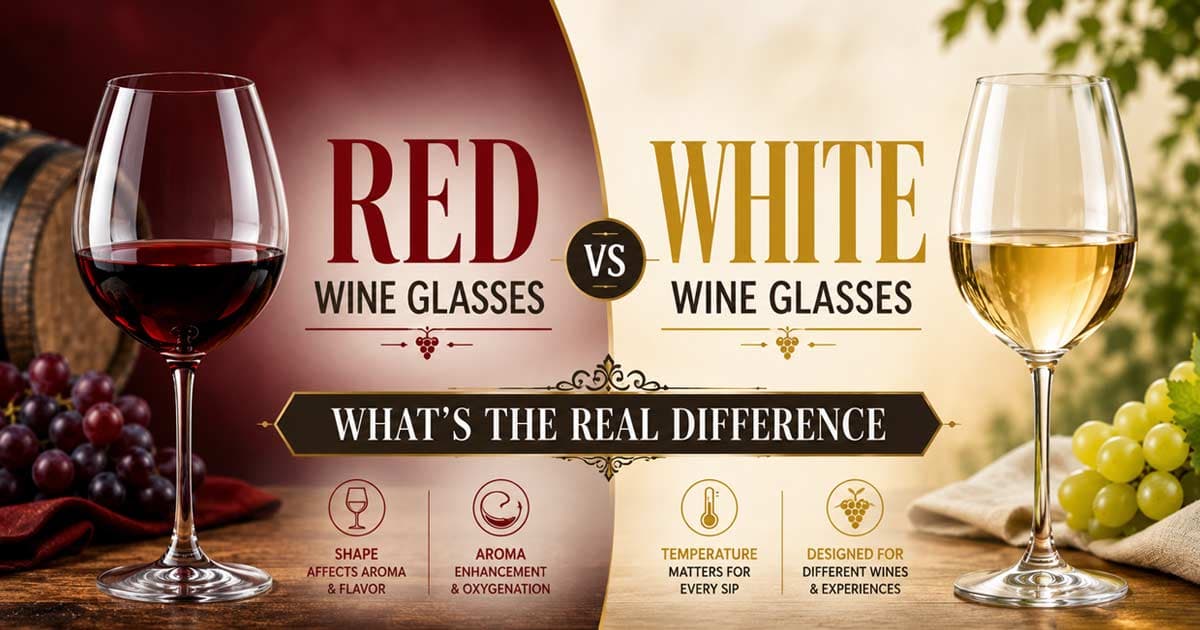
The short version: red wine glasses are built to give wine air; white wine glasses are built to protect it.
Red wines generally carry more tannin, more alcohol and more layered aromatics. They benefit from contact with oxygen, which softens the grip of tannin and lets closed-in aromas unwind. So red glasses are larger, wider and taller, often 22 to 30 ounces, with the biggest Burgundy bowls reaching past 30. A standard five-ounce pour sits in the bottom fifth of a glass that size, with plenty of room to swirl.
White wines are usually built on acidity, freshness, and lighter, more volatile aromatics:s citrus, orchard fruit, white flowers. Those aromas escape quickly, and the wines are served cold. A smaller bowl, often 10 to 16 ounces, holds the aromas closer, keeps the wine’s exposed surface down, and gets the wine to your lips before it warms.
There’s one more practical difference worth knowing. Red glasses tend to have longer stems, and not for looks — a longer stem keeps your hand further from the bowl.
| Feature | Red Wine Glass | White Wine Glass |
|---|---|---|
| Bowl size | Large and rounded | Smaller and narrower |
| Typical capacity | 22–30 oz | 10–16 oz |
| Opening at the rim | Wider | Narrower |
| Stem length | Longer | Shorter to medium |
| Oxygen exposure | High — aeration is the point | Low — preservation is the point |
| Aroma effect | Develops and softens complex aromas | Concentrates fresh, delicate aromas |
| Warms gently, which suits reds | Keeps wine cold for longer | |
| Serving temperature | 54–65°F | 43–55°F |
| Best for | Bold, tannic, structured wines | Crisp, aromatic, high-acid wines |
Why Are Red Wine Glasses Bigger?
Red wine glasses are bigger because a wider bowl exposes more of the wine’s surface to air. That oxygen contact softens tannin, the compound responsible for the drying, grippy sensation in bold reds,s and gives dense aromas the room they need to open up. Most red glasses hold between 22 and 30 ounces, roughly double a typical white wine glass.
The extra volume does three things:
- It aerates - More exposed surface means faster oxidation of the wine’s phenolic compounds — the same effect a decanter produces, just gentler and slower.
- It concentrates aroma where it counts - A large bowl gives aromatics room to develop, while the taper toward the rim gathers them before they escape.
- It gives you room to swirl - With five ounces in a 28-ounce bowl, you can swirl properly without wearing your Barolo, and swirling is what accelerates aeration in the first place.
This matters most for structured, full-bodied wines where the tannin is firm enough that a few minutes of air makes a noticeable difference: Bordeaux and Bordeaux-style blends, Napa Cabernet, Syrah and Malbec. If you want to put the theory to work, explore our red wines and try the same bottle across two shapes.
Why Are White Wine Glasses Smaller?
White wine glasses are smaller because white wine’s best qualities are the ones that disappear fastest.
Most whites are built on bright acidity and light, volatile aromatics: lime, green apple, white peach, jasmine. Those compounds lift out of the glass quickly, and unlike tannin, they don’t improve with air. Give a delicate Sauvignon Blanc half an hour in a Burgundy bowl, and you’ll mostly have lost the reason you opened it.
Temperature is the other half. Whites are served between roughly 43°F and 55°F, and a smaller bowl helps in three ways at once: less wine per pour means less time in the glass, less exposed surface means slower warming, and a narrower bowl sits further from the heat of your hand.
White wines also carry little or no tannin, so there’s simply nothing there for oxygen to soften. Where a red glass is trying to change the wine, a white glass is trying to keep it exactly as it was when it left the bottle. The same logic applies to lighter summer styles and to rosé.
Wine Glass Sizes: How Many Ounces Should Each Glass Hold?
Capacity is the specification most people never think to check, and it explains almost everything else about how a glass behaves. Here’s how the common shapes compare, alongside the standard five-ounce pour.
| Glass Type | Typical Capacity | Standard Pour | Roughly How Full |
|---|---|---|---|
| Bordeaux (Cabernet, Merlot) | 22–30 oz / 650–880 ml | 5 oz / 150 ml | One-fifth |
| Burgundy (Pinot Noir) | 24–32 oz / 700–950 ml | 5 oz / 150 ml | One-sixth |
| Universal | 15–19 oz / 440–560 ml | 5 oz / 150 ml | One-third |
| Chardonnay / Full-Bodied White | 12–16 oz / 350–470 ml | 5 oz / 150 ml | One-third |
| Aromatic White | 10–14 oz / 300–410 ml | 5 oz / 150 ml | Two-fifths |
| ISO Tasting Glass | 7.25 oz / 215 ml | 1.7 oz / 50 ml | One-quarter |
Capacities vary by range and manufacturer — check the specification of the glasses you own or stock.
Why Is the Glass Only a Third Full?
Because the space is doing a job. The gap between the wine and the rim is where aroma collects, and it’s the room you need to swirl without spilling. A five-ounce pour in a 28-ounce Bordeaux glass looks sparse, but fill that glass halfway, and you lose both the swirl and the concentrated column of aroma at the rim.
The practical target: pour to the widest part of the bowl and stop. On most glasses, that lands between a fifth and a third full,l roughly five glasses from a standard 750 ml bottle, depending on how generous the pour is.
Serving Temperature: The Other Half of the Equation
Glass shape and serving temperature work on the same problem from two directions. Temperature governs how quickly aromatic compounds volatilize and how sharp the acidity reads; the glass governs how long that temperature holds. Get one right and ignore the other and you’ve wasted the effort.
One correction worth making, because it catches almost everyone: most reds are served too warm and most whites too cold. “Room temperature” dates from an era of considerably colder rooms.
| Wine Style | Serving Temperature | Practical Tip |
|---|---|---|
| Sparkling | 43–50°F / 6–10°C | Straight from the fridge |
| Light, Aromatic Whites | 45–50°F / 7–10°C | Fridge, then 10 minutes out |
| Full-Bodied Whites | 50–55°F / 10–13°C | Fridge, then 20–30 minutes out |
| Rosé | 46–54°F / 8–12°C | Treat like a light white |
| Light Reds (Pinot Noir, Gamay) | 54–59°F / 12–15°C | 20 minutes in the fridge helps |
| Full-Bodied Reds | 60–65°F / 15–18°C | Cooler than most rooms |
Types of Red Wine Glasses
There are dozens of specialized designs from makers like Riedel, Zalto, Gabriel-Glas, and Schott Zwiesel. The idea itself traces back to Claus Riedel, who developed the first glasses shaped around a single grape variety in the 1950s and '60s. These are the three shapes that account for most of what you'll actually encounter.
Bordeaux Glass
Tall, with a broad bowl and a relatively narrow rim. Typically 22 to 26 ounces.
Best for Cabernet Sauvignon, Merlot, Cabernet Franc, Malbec, Syrah and Bordeaux blends.
The height gives aromas a longer column to travel and delivers the wine further back in the mouth, which suits full-bodied wines with firm tannin — the extra air softens the grip before it reaches you.
Burgundy Glass
Recognizable by its wide, rounded, almost balloon-like bowl that pulls in sharply at the rim. Often the largest glass on the table at 24 to 32 ounces.
Best for Pinot Noir, Nebbiolo (including Barolo and Barbaresco), Gamay and Grenache. Some producers make a dedicated Nebbiolo glass with a taller, narrower profile, but a Burgundy bowl is a solid practical substitute.
These are wines built on perfume rather than power. The wide base gives delicate aromatics maximum surface to develop; the sharp taper then funnels them into a concentrated column at the rim. It’s the most dramatic glass in terms of what it does to a wine pou: pour a good Pinot Noir into a Burgundy bowl and then into a tumbler, and the difference is not subtle.
Universal Red Wine Glass
If you’re only buying one shape, buy this one.
A universal glass — usually 15 to 19 ounces, with a moderately wide bowl and a rim that tapers in sits deliberately between a Bordeaux glass and a white wine glass. It's roomy enough to aerate a Cabernet and swirl it properly, but not so large that a chilled Riesling loses its edge before you finish it. Our Tiffany glass is a great example of this shape done well.
It won’t flatter a great Barolo the way a dedicated Burgundy bowl does. For everything else, the difference is small enough that most people never notice, which is exactly why a growing number of restaurants and wine bars have moved to a single universal glass across the entire list. The economics help too: one shape means simpler storage, fewer breakages and faster service.
Types of White Wine Glasses
White wine glasses vary less dramatically than reds, but the distinction between aromatic and full-bodied styles is worth knowing.
Aromatic White Wine Glass
Narrower, with a smaller bowl — usually 10 to 14 ounces.
Best for Sauvignon Blanc, Riesling, Albariño, Pinot Grigio and Chenin Blanc.
The tighter shape holds fresh fruit and floral notes close to the rim rather than letting them disperse, and the reduced surface area keeps the wine colder for longer. For high-acid, aromatic whites, both effects pull in the same direction.
Chardonnay Glass
Wider than the aromatic white glass, with a slightly flared rim — usually 12 to 16 ounces.
Best for oaked Chardonnay, white Burgundy, aged white Rioja and other fuller-bodied whites.
Richer whites have more in common with light reds than with a crisp Sauvignon Blanc: more texture, more weight, often some oak influence. They need a little air to unwind, and the wider bowl gives it to them while still keeping the wine cool enough to stay fresh.
Universal White Wine Glass
A universal white wine glass, ss usually 12 to 16 ounces, covers nearly every white you’re likely to open, from a taut Albariño to a barrel-aged Chardonnay.
It’s a sensible compromise: wide enough that a richer white can breathe, narrow enough that a crisp, aromatic one keeps its focus and its chill. If you’d rather own six good glasses than sixteen specialized ones, this is the white wine equivalent of the universal red. Browse our white wines to put it to work.
Can You Use the Same Glass for Both?
Yes — and for most people, most of the time, you should.
A good universal glass of around 15 to 19 ounces performs genuinely well across red wine, white wine, rosé and even sparkling wine, particularly vintage Champagne, which has more to say than a narrow flute allows it to.
You give up a little at the extremes. A structured Barolo shows better in a Burgundy bowl; a razor-sharp Muscadet stays crisper in something smaller. But “a little” is the honest description — for everyday drinking the gap is far smaller than the glassware industry would like you to believe. If you’re building a collection from scratch, six good universal glasses will serve you better than a scattered mix of specialized ones.
Can a Wine Glass Really Change the Taste of Wine?
Technically, no. The wine in the bottle is the same wine whatever you pour it into. What changes is your perception of it — and in tasting, perception is the whole game.
Here’s what actually shifts:
- Aroma intensity - A bowl that tapers toward the rim delivers a denser column of aromatic vapor to your nose. The 2015 sniffer-camera imaging out of Tokyo showed this directly ethanol vapor concentrates in a ring near the rim, and both glass shape and wine temperature change where that vapor sits.
- Tannin perception - Aeration softens the astringent grip of a young red. Ten minutes in a large bowl can make a tight Cabernet taste noticeably rounder.
- Acid balance- Temperature drives perceived acidity, and glass size drives temperature. The same Chenin Blanc reads as bracing at 46°F and soft at 59°F.
- Mouthfeel and delivery - Rim width changes how the wine spreads across your palate — a thin, tapered rim delivers a narrower, more precise stream than a thick, flared one.
One caveat worth clearing up: you may have read that a glass “directs wine to a specific part of your tongue.” That comes from the old tongue-map theory, which sensory scientists discarded decades ago — all taste receptors detect all basic tastes. Glass shape works on aroma and on delivery, not on taste zones.
Want to prove it to yourself in two minutes? Pour the same wine into a coffee mug, a water tumbler and a proper wine glass. Smell each one before you taste. The mug flattens the aroma almost completely, the tumbler lets it scatter, and the wine glass concentrates it. It’s the fastest way to understand why any of this matters — and it costs nothing but a splash of wine.
Crystal or Glass: Does the Material Matter?
It does, though less than price tags suggest.
Crystal contains minerals, historically lead, now almost always titanium or barium in lead-free crystal that make the material stronger for its thickness. That allows a thinner bowl and a finer rim, which is what you actually feel when you drink from a good glass: the wine seems to arrive without an edge in the way. Crystal is also more refractive, so the wine looks brighter in it.
A standard glass is thicker, heavier, more durable and considerably cheaper. It’s the right choice for everyday use, outdoor drinking and any household where glasses get knocked over.
Modern lead-free crystal poses no safety concern for drinking. Vintage leaded crystal is best kept for serving rather than long-term storage of acidic liquids.
Are Expensive Wine Glasses Worth It?
Up to a point, clearly yes. The jump from a thick, heavy tumbler to a well-made thin-rimmed glass is obvious to anyone, wine knowledge or not. The jump from a good mid-range glass to a hand-blown showpiece is real but much smaller, and it comes with a fragility cost.
If you’re deciding where to spend: buy the best universal glass you can comfortably afford to break, and buy six of them. That beats two expensive glasses you’re afraid to use. A quality stemware set is usually better value than assembling singles.
What About Rosé, Sparkling and Dessert Wines?
Rosé follows the white wine rules. Serve it cold in a smaller bowl — an aromatic white glass or a universal glass both work well. Fuller, darker rosés from Provence or Rioja can take a slightly wider bowl.
Sparkling wine is the one genuine exception to everything above, because you’re managing bubbles as well as aroma. The narrow flute preserves the mousse but strangles the aroma; a tulip shape or a universal glass gives good Champagne room to show what it can do. We’ve covered the trade-offs in detail in Champagne glasses vs wine glasses.
Dessert and fortified wines are served in small quantities at higher sugar and alcohol, so they use small glasses — typically 6 to 8 ounces — with a narrow rim that keeps the alcohol from dominating the nose. A port glass is essentially a scaled-down red wine glass.
How to Care for Your Wine Glasses
Good glasses fail for two reasons: they break, and they pick up residue that quietly ruins the wine. Both are avoidable.
- Rinse straight away Wine dries into a film that’s much harder to remove later. Warm water immediately after use handles most of it.
- Go easy on detergent Residue is the enemy; it dulls aroma and flattens the bubbles in sparkling wine almost instantly. Use a small amount, or hot water alone for lightly used glasses.
- Hand-wash thin crystal Hold the bowl, never the stem, and never twist the bowl against the base;e that’s how stems snap. Machine-made glasses with pulled stems are generally dishwasher-safe on a gentle cycle; check the manufacturer’s guidance.
- Dry with a lint-free cloth Microfiber or linen. Support the bowl from inside with one hand rather than twisting the glass.
- Store upright Storing rim-down traps stale air and can chip the most fragile part of the glass. Upright on an open shelf is better than inverted in a cupboard.
- Keep them away from strong smells Glass picks up odors from cupboards, cardboard and dishcloths. If a glass has been stored for a while, rinse it before pouring
Which Wines Taste Best in Each Glass
You don’t need to memorize any of this — but if you want a quick reference for matching a wine to the glass that shows it best, here it is. Screenshot it for your next dinner party.
| Wine | Recommended Glass | Why |
|---|---|---|
| Cabernet Sauvignon | Bordeaux | Firm tannin needs air to soften. |
| Merlot | Bordeaux | Benefits from aeration, medium-full body. |
| Malbec | Bordeaux | Dark fruit opens up with oxygen. |
| Syrah / Shiraz | Bordeaux | Bold, peppery aromatics need room. |
| Zinfandel | Bordeaux | High alcohol needs space to blow off. |
| Bordeaux Blends | Bordeaux | Designed for exactly this shape. |
| Pinot Noir | Burgundy | Delicate perfume needs a wide bowl. |
| Nebbiolo (Barolo, Barbaresco) | Burgundy | Aromatic and tannic—needs both air and focus. |
| Gamay (Beaujolais) | Burgundy | Light-bodied and floral. |
| Grenache | Burgundy | Perfumed, softer tannin. |
| Sangiovese | Universal or Bordeaux | High acid, medium tannin. |
| Sauvignon Blanc | Aromatic White | Preserves citrus and herbal lift. |
| Riesling | Aromatic White | Protects floral notes and acidity. |
| Pinot Grigio | Aromatic White | Light and delicate—keep it cold. |
| Albariño | Aromatic White | Saline freshness fades in a wide bowl. |
| Chenin Blanc | Aromatic White | Aromatic, high acid. |
| Unoaked Chardonnay | Aromatic White | Closer to a crisp white than a rich one. |
| Oaked Chardonnay | Chardonnay | Texture and oak need a little air. |
| White Burgundy | Chardonnay | Complexity rewards a wider bowl. |
| Rosé | Aromatic White or Universal | Follows white wine logic. |
| Champagne / Sparkling | Tulip or Universal | Aroma matters more than a narrow flute allows. |
| Port & Dessert Wines | Small Dessert Glass | Small pour, high alcohol, narrow rim. |
What to Buy First: A Practical Starter Kit
Most glassware advice quietly assumes you’re building a collection. You probably aren’t. Here’s what actually makes sense at three different levels of commitment.
If you’re buying one thing
Six universal glasses, 15 to 19 ounces. This covers red, white, rosé and sparkling, handles a dinner party, and lets you replace breakages without rebuying a set. It is, by a wide margin, the best first purchase in wine.
If you want the two-glass solution
Six universal reds plus six aromatic whites. This is the point where the difference becomes genuinely noticeable: chilled whites stay chilled, and reds get the air they need. For most households this is the sensible ceiling.
If you’re building a collection
Add a dedicated Burgundy glass if you drink Pinot Noir or Nebbiolo, a Chardonnay glass if you drink white Burgundy, and a tulip for sparkling. Beyond that, you’re into diminishing returns and storage problems.
Wine glasses also make consistently good gifts — more so than wine itself, since they don’t depend on guessing someone’s taste. Our red and white wine gift guide has pairing ideas if you want to give both.
Final Thoughts
The red-versus-white glass question isn’t really about rules. It’s about getting more out of what’s already in your bottle.
Red wine glasses are built to give bold wines air — softening tannin, opening up aroma, giving you room to swirl. White wine glasses are built to hold the line — keeping the wine cold, keeping delicate aromatics close, protecting the freshness that made them worth chilling in the first place.
If you’re starting from scratch, buy six good universal glasses before you buy anything specialized. If you already love a particular style — Pinot Noir, or oaked Chardonnay — that’s where a dedicated shape earns its place.
And if you’re standing in your kitchen right now with a bottle open and only a tumbler to hand: pour it anyway. The best glass in the world is the one that’s actually full, in front of people whose company you enjoy.
Frequently Asked Questions
What is the main difference between a red and white wine glass?
Red wine glasses have larger, wider bowls — typically 22 to 30 ounces — to expose more wine to air, which softens tannin and develops complex aromas. White wine glasses are smaller, usually 10 to 16 ounces, to preserve delicate aromatics and keep the wine cold.
How many ounces is a red wine glass?
Most red wine glasses hold 22 to 30 ounces, though Burgundy glasses can exceed 32. The standard pour is 5 ounces regardless of glass size, which is why a red glass looks only a fifth full.
Can I use a red wine glass for white wine?
You can, and for a full-bodied white like an oaked Chardonnay it works well. For crisp, aromatic whites, a large bowl lets the wine warm faster and the delicate aromas disperse, so you lose some freshness.
Do wine glasses really change the taste of wine?
The wine itself doesn’t change — your perception of it does. Glass shape alters aroma concentration, how quickly the wine warms, and how it reaches your palate. Research imaging ethanol vapor above wine glasses has confirmed that shape and temperature measurably change the vapor pattern you smell.
Are stemless wine glasses bad for wine?
Not bad, just better suited to some situations than others. Holding the bowl transfers hand heat into the wine, which matters for anything chilled. Stemless glasses are excellent for casual reds and outdoor drinking, less ideal for whites and sparkling.
What is a universal wine glass?
A universal glass is a single shape, usually 15 to 19 ounces, designed to work acceptably across red, white, rosé and sparkling wine. Many restaurants now use them exclusively because the compromise is small and the practical benefits are large.
How many wine glasses do I actually need?
Six of one good universal shape covers almost everything, including a dinner party. Twelve — six reds and six whites — is the sensible ceiling for most households.
Is crystal better than glass for wine?
Crystal can be made thinner and finer, which gives a more refined rim and a brighter appearance. Standard glass is more durable and cheaper. Modern lead-free crystal is entirely safe to drink from.
Can wine glasses go in the dishwasher?
Many machine-made glasses can, on a gentle cycle with minimal detergent. Thin hand-blown crystal should be washed by hand. The bigger risk isn’t breakage — it’s detergent residue, which dulls aroma and kills the bubbles in sparkling wine.
Why do you only fill a wine glass a third of the way?
The space is where aroma collects, and it’s the room you need to swirl. Pour to the widest part of the bowl and stop — that’s about 5 ounces, and gives five glasses per bottle.
Ready to upgrade your stemware? Browse the full wine glass collection — universal sets, Bordeaux and Burgundy stemware, and gift-ready boxes.