
A good set of wine glasses is one of the few gifts that gets used, admired, and remembered. It survives the thank-you note. It comes out at anniversaries and birthdays and quiet Tuesday dinners, and every time it does, the person who gave it gets a small moment of credit.
Which raises the question most gift buyers get stuck on: do you go for personalized wine glasses, or a classic set of premium crystal?
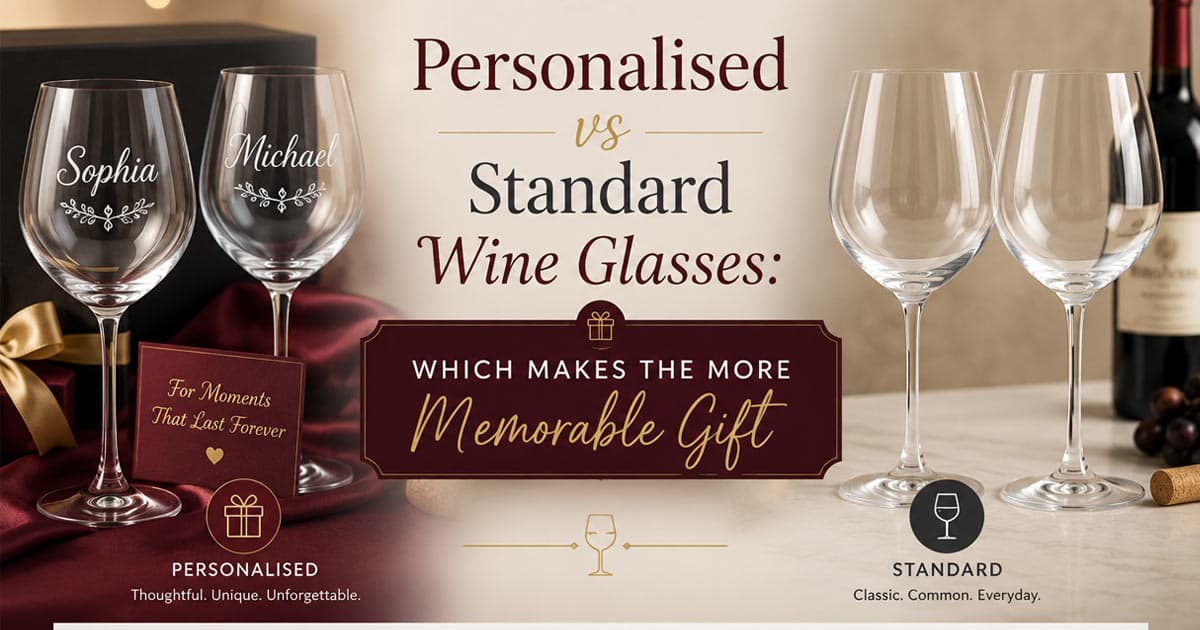
Both are good answers. They’re just good for different people. Premium standard glassware from a house like Riedel or Tiffany & Co. says I know quality when I see it. Engraving a date, a monogram or a few words says I was paying attention.
This guide compares the two on the things that actually decide it — cost, lead time, keepsake value and how each performs in the hand — and covers the practical details most gift guides skip: what engraving costs, how long it takes, what to have engraved, and why you usually can’t send it back.
Why Wine Glasses Make an Exceptional Gift
Most gifts have a short half-life. Glassware doesn’t. A good set stays in the cupboard for years and gets pulled out for the occasions that matter, which quietly ties the giver to a long run of pleasant evenings.
A well-made glass also does real work. It isn’t just drinkware; it changes the experience of the wine in it by shaping:
Aroma concentration — a bowl that narrows toward the rim gathers aromatics and delivers them to the nose
Flavor perception — most of what we read as flavor arrives through the nose, so aroma delivery is most of the game
Serving temperature — bowl size and stem length together decide how quickly the wine warms
Comfort at the rim — a fine, laser-cut rim lets wine arrive without a thick edge in the way
Presentation — the least technical factor and, for a gift, not the least important
Premium makers spend years on bowl geometry, rim thickness, stem balance and crystal composition. If you want the detail behind that, our guide to the difference between red and white wine glasses covers how shape changes what you taste.
Personalized Wine Glasses: A Gift with Emotional Value
Personalization usually means engraving — a monogram, a date, a short line of text, a wedding motif, a family crest or a company mark, cut into the glass rather than printed on it.
What it buys you is specificity. A premium glass is an excellent gift for anyone who likes wine. An engraved glass is a gift for one person, on one occasion, and it keeps saying so. Glasses engraved with a wedding date get used on anniversaries. A retirement monogram gets explained to guests years later. That’s a different category of object from good glassware it’s a keepsake that happens to be useful.
The Best Occasions for Personalized Wine Glasses
Engraving works best when there’s a specific moment to mark:
- Weddings — engraved flutes for the couple, or for the wedding party
- Anniversaries — a date the recipient already celebrates
- Birthdays — particularly milestone years
- Retirement — a career worth marking properly
- Corporate appreciation — client and executive gifting
- Housewarmings — a first set for a new home
- Graduations — a grown-up gift for a new chapter
For weddings and milestone celebrations, engraved champagne flutes are the most requested format. A personalized flute set paired with Dom Pérignon or with La Marca Prosecco covers both the toast and the keepsake.
How Wine Glass Engraving Actually Works
“Engraved” covers three different processes, and the difference matters if you care how the finished glass looks and lasts.
| Method | How it Works | Best For | Finish & Durability |
|---|---|---|---|
| Laser Engraving | A focused beam heats a tiny area of the surface, causing controlled micro-fracturing | Precise text, logos, matched sets | Permanent, crisp, frosted-white; stands up to regular washing |
| Sandblasting | Abrasive media is driven through a stencil to remove glass in controlled layers | Deeper designs, larger artwork, tactile results | The deepest and most enduring of the three |
| Diamond/Rotary | A hand-held diamond tip cuts detail directly into the surface. | One-off pieces, script, fine artwork. | Permanent, with visible hand-worked character. |
Where on the Glass Can You Engrave?
Reputable engravers work on the base, the stem or the lower bowl — never the rim or the upper bowl.
The reason is structural. The rim and upper bowl are the thinnest parts of a wine glass and carry the most stress, both from handling and from temperature changes in the dishwasher. Cutting into them is asking for a crack. The base and lower bowl are thicker, better supported, and sit below the wine line where the engraving reads clearly without interrupting anything.
It’s also where engraving looks best. A monogram at the base catches light through the bowl. The same monogram at the rim would sit in your line of sight every time you raised the glass.
Standard Premium Wine Glasses: Craftsmanship First
Premium standard glassware makes the opposite bet: no customization, everything invested in the glass itself.
For someone who takes wine seriously, that lands well. A set of Riedel stemware can be as welcome as a good bottle; it reads as proper equipment rather than another household object. These glasses are valued for exceptional balance in the hand, genuine crystal clarity, fine laser-cut rims, consistent performance across a range, and durability that justifies the price if they’re looked after.
Tiffany & Co. approaches it from the design side, producing crystal barware wine glasses, stemless glasses and champagne flutes with the same attention to bowl shape, rim thinness and stem balance, in a form that carries obvious gifting weight.
Why Wine Professionals Often Prefer Standard Premium Glasses
Experienced drinkers tend to prioritize performance, and in a wine glass, performance comes down to bowl size and shape, rim angle and thickness, stem height, crystal thickness, and overall weight.
This is where Riedel transformed modern wine glass design. Claus J. Riedel pioneered modern wine-focused glass design in the late 1950s and introduced the Sommeliers collection in 1973, the world’s first range of glasses designed around individual grape varieties. The Burgundy Grand Cru shape from that lineage dates to 1958 and sits in the permanent design collection of the Museum of Modern Art in New York.
The purpose is aroma delivery: different bowl geometries concentrate and release a wine’s aromatics differently, which is why a Pinot Noir and a Cabernet are served in different shapes. One old claim worth retiring:g you may read that glass shape "directs wine to different parts of the palate." That comes from the tongue-map theory, which sensory scientists discarded decades ago. All taste receptors detect all basic tastes. Shape works on aroma and on how the wine arrives, not on taste zones.
Personalized vs Standard Wine Glasses: Side by Side
The honest summary is that these two gifts optimize for different things, and neither is better in the abstract.
Personalized glasses buy meaning. They’re tied to a person and a moment, and that tie is what makes them memorable, but it also makes them slower to produce, harder to replace, and effectively final once cut.
Standard premium glasses buy performance and flexibility. They ship immediately, they’re returnable, they can be replaced one at a time when one inevitably breaks, and they’ll be genuinely better in the hand than most engraved options at the same price because the whole budget went into the glass.
| Factor | Personalized Glasses | Standard Premium Glasses |
|---|---|---|
| Typical Price per Glass | $30-$300 | $20-$200 |
| Added Cost to Personalize | Approx. $20-$40 per glass | None |
| Lead Time | 1-2 business days | Ships immediately |
| Returnable | Usually not — engraving is final. | Yes, under standard return policy. |
| Tasting Performance | Depends entirely on the base glass. | Consistently high. |
| Keepsake Value | High — tied to a specific occasion. | Moderate — tied to quality. |
| Replacing a Breakage | Requires re-engraving to match. | Simply purchase another from the same range. |
| Everyday Usability | Often reserved for special occasions. | Used freely for everyday enjoyment. |
| Best For | Weddings, anniversaries, milestone celebrations, corporate gifts. | Wine enthusiasts, collectors, hosts, and daily use. |
How Long Does Engraving Take, and What Does It Cost?
This is the question that decides whether a personalized gift is even possible, and it’s the one most guides leave out.
- Lead time - Engraving adds 1-2 business days to a standard order, before shipping. For a dated occasion, work backwards: engraving time, plus delivery time, plus a couple of days of margin. If you’re inside that window, premium standard glassware is the better call a rushed engraving job is worse than no engraving at all.
- Cost - Personalization typically adds [approximately $20 per glass], depending on the design. A monogram costs less than a multi-line message; a logo with fine detail costs more than block initials. The base glass is the larger part of the total either way.
- Order-by guidance -For Christmas and Valentine’s Day, engraving queues lengthen considerably, ordering [X weeks] ahead rather than [X days].
Can Personalized Glasses Be Returned?
Rarely, and it’s worth being direct about it. Once a name is cut into a glass, that glass can’t be resold, so personalized items sit outside standard return policies nearly everywhere — see our returns policy for the specifics.
Which makes proofreading the most important step in the process. Check the spelling of the name as they spell it. Check the date format. Check the character count against the limit. Read it aloud once. Engraving is permanent in a way almost nothing else you buy is.
What Should You Actually Engrave?
The most common mistake is overwriting. A glass has a small canvas and a long life, and the things that read well in year one an inside joke, a long quote often age badly. Restraint holds up.
What works, by occasion:- Wedding — two sets of initials and the date, or a simple joined monogram
- Anniversary — the year alone, or "Est. [year]"
- Milestone birthday — initials with the year, rather than the age
- Retirement — name and years of service, or the company mark kept small
- Housewarming — a family name or a house name
- Graduation — initials with the graduation year
- Corporate — a discreet logo on the base, never across the bowl
What to avoid: long quotations, anything that dates quickly, nicknames the recipient may outgrow, and text large enough to see across a room. If in doubt, engrave less. A monogram is never the wrong answer.
How Many Glasses Should You Give?
Two for a couple, an engagement, or an anniversary;y a pair reads as intentional rather than incomplete.
Four for a housewarming or a general gift, which covers a small dinner.
Six for someone who entertains, or as a wedding gift to a household. Six is the point at which a set stops being decorative and starts being used.
For engraved sets, remember that a broken glass can’t be quietly replaced from stock. Giving six rather than four builds in some tolerance for the years ahead.
Which Gift Creates Stronger Memories?
It depends on what the recipient values, and you usually know which of these two people you’re buying for.
If they value occasions and sentiment, choose personalized. The engraving becomes part of the memory of the event, and every future use points back to it and to you.
If they’re serious about wine, choose premium standard glassware. To someone who cares about this, receiving proper crystal from a respected house feels like being given good tools. An engraved glass of lesser quality doesn’t land the same way, however thoughtful the message.
If you genuinely can’t tell, the next section is your answer.
Can You Combine Both?
Yes, and for most buyers this is the right call.
Premium crystal can be professionally engraved, which gives you the performance of a serious glass and the specificity of a keepsake in one object. In practice, that looks like a pair of engraved Riedel red wine glasses, crystal champagne flutes with the wedding date on the base, or Burgundy glasses carrying a small monogram
Two conditions make this work. Use an experienced engraver; fine crystal is thinner and less forgiving than standard glass, and the margin for error is smaller. And keep the design small and low on the glass, so the engraving complements the piece instead of competing with it. Our engraved wine glasses are worked on exactly this basis.
Does Engraving Affect Wine Quality?
No, provided it’s placed correctly, which is the whole reason engravers work on the base, stem, and lower bowl.
Aroma concentration is governed by the shape of the upper bowl and the rim: how the glass narrows, how wide the opening is, how thin the edge is. Engraving below the wine line doesn’t touch any of that. The wine sits in the same bowl, the aromatics gather in the same space, and the rim meets your lip exactly as the maker designed it.
Drinking comfort is unaffected for the same reason. You never touch the engraving with your mouth, and on the base you rarely touch it at all.
Poorly placed engraving is a different story. Cutting near the rim or high on the bowl removes material from the thinnest, most stressed part of the glass and interrupts the surface where your lip meets it. This is the single clearest reason to use a specialist rather than the cheapest available option.
Choosing the Right Glass Before You Personalize
Engraving a glass that suits the recipient’s wine matters more than the engraving itself. Start here, then personalize.
| Glass Style | Suits | Give It When |
|---|---|---|
| Red Wine Glasses | Cabernet Sauvignon, Merlot, Shiraz, Bordeaux blends | They drink mostly reds — larger bowls aid aeration and aroma |
| White Wine Glasses | Sauvignon Blanc, Chardonnay, Riesling, rosé | They drink mostly whites — smaller bowls hold freshness and chill |
| Champagne flutes or tulips | Champagne, Prosecco, Sparkling Wine | Weddings, anniversaries and milestones; tulips balance bubbles and aroma better than narrow flutes |
| Universal Wine Glasses | Red, White, Rosé, and Sparkling Wines | You don’t know their preference — the safest single choice |
If they’re new to wine, our guide to the best wine glass for beginners is a good place to start, and Champagne glasses vs wine glasses covers the sparkling question in more detail.
Premium Brands Worth Considering
Riedel — the house that created varietal-specific stemware, with ranges running from everyday machine-made crystal to mouth-blown collector pieces. The obvious choice for someone who takes wine seriously.
Tiffany & Co. — crystal barware with unmistakable gifting weight, popular for weddings, anniversaries and formal entertaining, where the box carries as much meaning as the glass.
Zalto and Gabriel-Gla/s — exceptionally light, thin and unadorned; the enthusiast’s enthusiast choice. Handle with care.
Spiegelau and Schott Zwiesel — excellent craftsmanship at more accessible prices, with better everyday durability. Schott Zwiesel’s titanium-reinforced crystal is the practical pick for a household that uses its glasses daily.
Caring for Engraved Wine Glasses
Engraving is permanent. The glass around it isn’t, so a little care goes a long way.
- Rinse soon after use - Wine dries into a film, and it settles into engraved detail more stubbornly than on smooth glass.
- Hand-wash fine crystal - Hold the bowl rather than the stem, and never twist the bowl against the base; that’s how stems break. Machine-made engraved glasses are generally dishwasher-safe on a gentle cycle; check the maker’s guidance.
- Use minimal detergent - Residue dulls aroma and flattens sparkling wine almost immediately. It also builds up in engraved areas and clouds them over time.
- Use a soft brush on the engraving - A soft toothbrush lifts residue out of the detail without scratching.
- Dry with a lint-free cloth - Microfiber or linen cloth, supporting the bowl from inside rather than twisting.
- Store upright - Rim-down traps stale air and risks chipping the most fragile part of the glass.
Tips for Choosing the Perfect Wine Glass Gift
Match the glass to what they actually drink, not to what you drink.
- Check your lead time before you commit - If the occasion is close, buy premium standard glassware and give it properly rather than rushing an engraving.
- Proofread the engraving twice, then once more - It cannot be undone and usually cannot be returned.
- Keep the design small and low - Understated engraving ages better and respects the shape of the glass.
- Buy from a specialist - Engraving fine crystals is skilled work, and the failure mode is a ruined glass.
- Add a bottle worth drinking - Glasses plus a good bottle is a complete gift; our wine gift pairing ideas can help you choose.
- Don’t skip the presentation - A premium gift box is most of the first impression.
Final Verdict: Which Is More Memorable?
If the goal is an emotional keepsake, personalized wine glasses win. They mark a specific moment, and they keep marking it every toast for the next twenty years, pointing back to the occasion and to whoever gave them.
If you’re buying for someone genuinely passionate about wine, premium crystal from a house like Riedel or Tiffany & Co. is the better gift. It delivers performance they’ll notice on the first pour and durability that justifies the outlay.
And if you want the strongest version of this gift: buy the good crystal, then have it discreetly engraved. You give a beautiful object that works properly and a reason to remember where it came from — which is about as much as any gift can do.
Frequently Asked Questions
Are personalized wine glasses a good gift?
They are, particularly when there is a specific occasion to mark. Engraving ties the gift to a date and a person, which is what makes it a keepsake rather than glassware. For someone who is serious about wine and has no particular occasion, premium standard crystal usually lands better.
How long does it take to engrave wine glasses?
Engraving typically adds 1-2 business days before shipping. Work backwards from the occasion and allow for delivery plus a few days of margin. Around Christmas and Valentine’s Day, allow considerably longer.
How much does it cost to personalize a wine glass?
Personalization usually adds approximately $10 to $50 per glass. A simple monogram costs less than a multi-line message or a detailed logo. The base glass remains the larger share of the total.
Can engraved wine glasses go in the dishwasher?
Machine-made engraved glasses are generally dishwasher-safe on a gentle cycle with minimal detergent. Fine crystal should be hand-washed. Engraving itself does not wash off; the risk is detergent residue collecting in the detail and clouding it.
Does engraving affect the taste of wine?
No, provided it is placed on the base, stem, or lower bowl. Aroma is governed by the upper bowl and rim, which professional engraving never touches. Engraving near the rim is a different matter and should be avoided.
Can personalized wine glasses be returned?
Usually not. Because an engraved item cannot be resold, personalized goods generally fall outside standard return policies. Proofread the spelling, date, and character count carefully before ordering.
What should I engrave on a wine glass?
Initials, a date, or "Est. [year]" work across almost every occasion and age well. Avoid long quotations, nicknames,s and anything tied to a passing moment. If you are unsure, a monogram is never wrong.
How many wine glasses should I give as a gift?
Two for a couple, four for a general gift or housewarming, six for someone who entertains. For engraved sets, consider six rather than four; a broken glass cannot be replaced from stock without re-engraving.
Can you engrave premium crystal like Riedel or Tiffany?
Yes, and it is often the best of both options. Fine crystal is thinner and less forgiving than standard glass, so use an experienced engraver and keep the design small and low on the piece.
What is the difference between etched and engraved glass?
Engraving cuts into the surface by laser, sandblasting, a stylus, or a diamond tip, leaving a depth you can feel. Etching treats the surface chemically to create a frosted effect without cutting as deep. Engraving is generally more durable and more precise for text.
Ready to choose? Browse personalized wine glasses and engraved gift sets — or shop premium stemware from Riedel and Tiffany & Co Set. if you’d rather let the glass speak for itself.